
 sales@abaw.ae

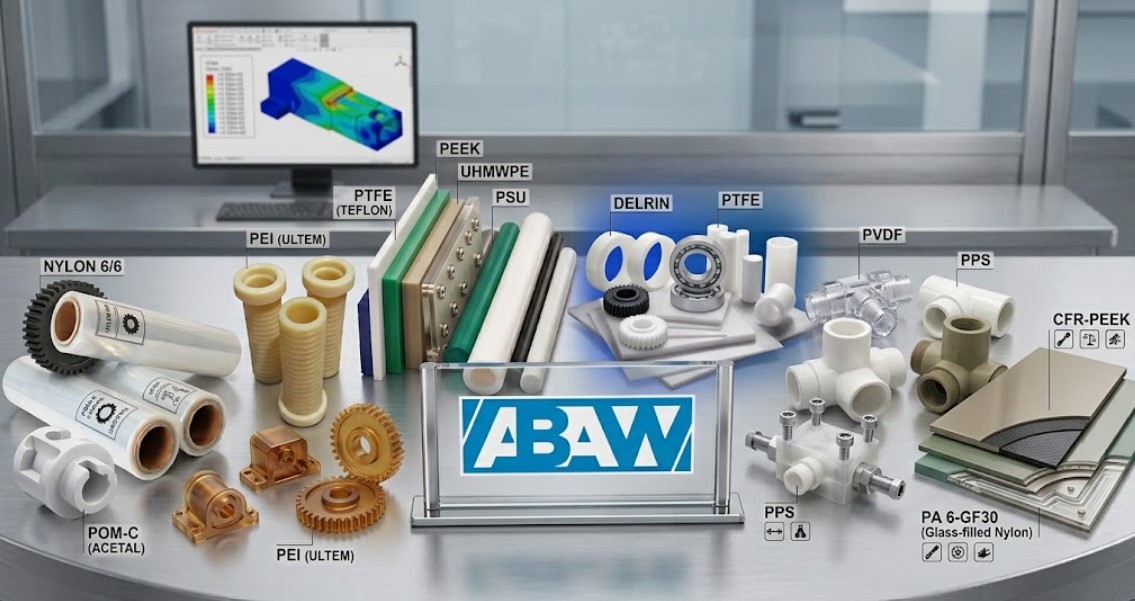
Engineering plastics are widely used in manufacturing, machinery, construction, fabrication, and industrial equipment. These materials offer a combination of mechanical strength, chemical resistance, wear resistance, and dimensional stability, making them suitable for components that operate under demanding conditions.
Choosing the right engineering plastic depends on the application's temperature, load, friction, chemical exposure, and environmental requirements. Materials such as HDPE, Nylon PA6, POM, PTFE, and PVC each offer different properties for specific industrial applications.
What Are Engineering Plastics?
Engineering plastics are polymer materials designed to provide specific mechanical, thermal, chemical, and electrical properties. They are available in various forms, including plastic rods, sheets, plates, tubes, and machined components.
Unlike many general-purpose plastics, engineering plastics are selected for applications requiring reliable performance under mechanical stress, repeated movement, or exposure to industrial environments. Depending on the grade, they can also offer advantages such as low weight, corrosion resistance, and reduced friction.
Common applications include gears, bushes, bearings, rollers, seals, machine guards, electrical insulation components, and protective panels. The correct material depends on the component's design and operating conditions.
Types of Engineering Plastics
Different engineering plastics offer specific advantages for industrial use. Understanding their characteristics helps manufacturers and maintenance teams select suitable materials for their requirements.
1. HDPE (High-Density Polyethylene)
HDPE is a lightweight engineering plastic known for its chemical resistance, impact resistance, and low moisture absorption. It is easy to fabricate and suitable for applications involving water, many chemicals, and general industrial handling.
Key properties of HDPE include:
 Good resistance to many chemicals.
- Low moisture absorption.
- Good impact resistance.
- Lightweight construction and easy fabrication.
- Relatively low friction.
HDPE is commonly used for chemical tanks, industrial liners, cutting boards, protective panels, and fabricated components. However, its stiffness and resistance to sustained mechanical loads may be lower than those of several other engineering plastics.
2. Nylon PA6 (Polyamide 6)
Nylon PA6 is valued for its mechanical strength, toughness, and wear resistance. It is frequently used to manufacture components exposed to friction, movement, and repeated mechanical loading.
Its main properties include:
- High mechanical strength.
- Good abrasion resistance.
- Good toughness and impact performance.
- Suitability for sliding and rotating components.
- Moisture absorption that can affect dimensions.
Common applications include gears, bushes, rollers, pulleys, wear pads, and machine components. Nylon PA6 is particularly useful for moving parts, although moisture absorption and operating temperature should be considered when precise tolerances are required.
3. POM (Acetal)
POM, also known as acetal, is an engineering plastic used for precision components that require stiffness, low friction, and dimensional stability. It is suitable for applications where consistent dimensions and good machinability are important.
Key benefits include:
- Good dimensional stability.
- Low friction and good wear resistance.
- High stiffness.
- Good machinability.
- Lower moisture absorption than Nylon PA6.
POM is commonly used for precision gears, bearings, conveyor components, valve parts, and mechanical assemblies. Its chemical compatibility and temperature limitations should be evaluated before use in demanding environments.
4. PTFE (Polytetrafluoroethylene)
PTFE is known for its very low friction and excellent resistance to a broad range of chemicals. It also provides useful electrical insulation and performs across a wide temperature range, depending on the application.
Its main properties include:
- Very low coefficient of friction.
- Excellent chemical resistance.
- Good electrical insulation.
- Useful high-temperature performance.
- Low stiffness compared with many structural engineering plastics.
PTFE is widely used for seals, gaskets, valve seats, chemical-processing components, and sliding surfaces. Because it can deform under sustained pressure, its suitability for load-bearing applications must be assessed carefully.
5. PVC (Polyvinyl Chloride)
PVC is a versatile plastic available in rigid and flexible formulations. Rigid PVC is frequently used in industrial fabrication and fluid-handling applications because it resists many acids and alkalis.
Its advantages include:
- Good resistance to many acids and alkalis.
- Electrical insulation properties.
- Ease of fabrication.
- Availability in different formulations.
- Suitability for various industrial applications.
Common uses include pipes, fittings, chemical-handling systems, protective covers, and fabricated panels. The correct grade must be selected according to chemical concentration, temperature, pressure, and mechanical requirements.
6. Polycarbonate (PC)
Polycarbonate is a transparent engineering thermoplastic known for its high impact resistance. It is particularly useful when equipment protection and visibility are both required.
Important properties include:
- High impact resistance.
- Optical transparency in suitable grades.
- Good dimensional stability.
- Electrical insulation properties.
- Sensitivity to certain chemicals and environmental conditions.
Typical applications include machine safety guards, protective glazing, equipment covers, and transparent industrial panels. The selected grade should meet the impact, temperature, and safety requirements of the intended application.
Key Properties of Engineering Plastics
The performance of an engineering plastic depends on its material composition, grade, manufacturing process, and operating environment. Evaluating the following properties helps prevent premature wear, deformation, and component failure.
- Mechanical strength: Determines how well the material withstands applied forces and mechanical loads.
- Wear resistance: Important for moving components such as gears, bushes, bearings, and conveyor guides.
- Chemical resistance: Helps determine suitability for contact with oils, solvents, acids, alkalis, and other substances.
- Temperature resistance: Indicates whether the material can retain its required properties under operating heat.
- Dimensional stability: Essential for precision-machined components and applications requiring tight tolerances.
- Moisture absorption: Can influence dimensions and mechanical performance, particularly in materials such as Nylon PA6.
- Friction: Affects movement, heat generation, wear, and the performance of sliding components.
- Electrical insulation: Relevant to electrical enclosures, connectors, and insulating components.
No single engineering plastic provides the best performance across every category. Material selection should consider the combined requirements of the application rather than relying on one property alone.
Common Industrial Uses of Engineering Plastics
Engineering plastics support a wide range of industrial applications because different polymers can meet specific mechanical, chemical, and manufacturing requirements.
Manufacturing and Machinery
Nylon PA6 and POM are commonly used for gears, bushes, rollers, guide rails, and wear components. Their mechanical properties and wear resistance make them suitable for applications involving repeated movement and friction.
Chemical Processing
HDPE, PVC, and PTFE are used in selected chemical-handling applications. Their suitability depends on the specific chemical, concentration, temperature, and duration of exposure.
Electrical and Electronics
Polycarbonate, PBT, and other suitable plastics are used for electrical enclosures, connectors, insulation components, and protective covers. The material must meet the relevant voltage, temperature, and safety requirements.
Construction and Fabrication
Engineering plastic rods and sheets can be machined into spacers, liners, protective panels, machine guards, and custom components. Their suitability depends on the required strength, impact resistance, environmental exposure, and fabrication method.
How to Choose the Right Engineering Plastic
Selecting the correct engineering plastic starts with understanding the component's operating conditions and performance requirements.
Consider these factors before choosing a material:
- Application requirements: Identify whether the component is stationary, moving, load-bearing, or exposed to chemicals.
- Mechanical loading: Evaluate continuous loads, impact forces, friction, and wear.
- Operating temperature: Check normal temperatures and any short-term temperature peaks.
- Chemical compatibility: Confirm resistance to the exact chemicals and their concentrations.
- Environmental exposure: Consider moisture, humidity, UV radiation, and outdoor conditions.
- Material dimensions: Determine whether rods, sheets, plates, or tubes are appropriate for fabrication.
- Technical documentation: Review manufacturer datasheets, grade specifications, and applicable compliance requirements.
Machining requirements, material availability, service life, and maintenance costs should also influence the decision. Reviewing these factors helps businesses select materials that meet operational requirements without unnecessary replacement or downtime.
Engineering Plastics Supplier in UAE
Businesses across the UAE require engineering plastics for manufacturing, industrial maintenance, fabrication, construction, and equipment production. Choosing suitable plastic rods and sheets helps support component manufacturing and industrial operations.
Al Burhan Al Wadeh supplies engineering plastic products, including HDPE and Nylon PA6, for different industrial requirements. Material selection should be based on the required dimensions, operating conditions, and technical specifications.
Before ordering, confirm the required grade, dimensions, availability, and relevant technical documentation. For specialized applications, consult the supplier to identify suitable material options.
If you require plastic rods or sheets for your next project, contact ABAW to discuss your application and material requirements.
FAQs
What are the most commonly used engineering plastics?
Common engineering plastics include HDPE, Nylon PA6, POM, PTFE, PVC, polycarbonate, PET, and PBT. Each material offers different properties for applications involving mechanical strength, wear resistance, chemical compatibility, and temperature performance.
What is the difference between HDPE and Nylon PA6?
HDPE offers good chemical resistance, impact resistance, and low moisture absorption. Nylon PA6 generally provides higher mechanical strength and wear resistance for many moving components, but it absorbs more moisture, which can affect dimensions.
Where are engineering plastic rods and sheets used?
Engineering plastic rods and sheets are used to manufacture gears, bushes, rollers, machine guards, liners, seals, electrical components, and fabricated parts. The correct material depends on the application's strength, temperature, chemical resistance, and dimensional requirements.