
 sales@abaw.ae

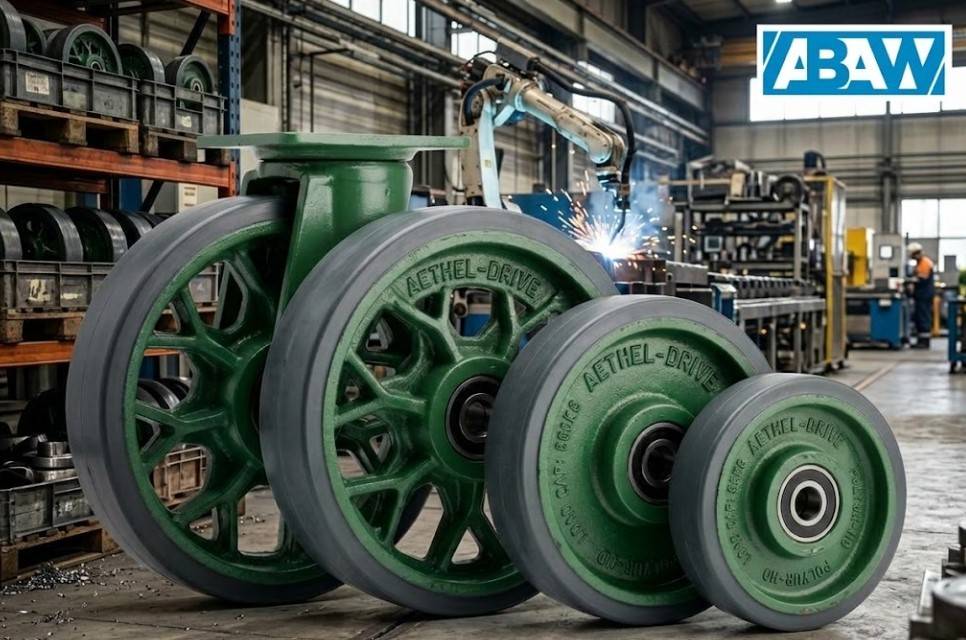
Overloaded casters are a common cause of damaged carts, trolleys, and workplace strain injuries. Bent forks, flattened wheels, and seized bearings usually trace back to one mistake: guessing the weight each wheel carries.
Knowing how to calculate caster wheel load capacity removes that guess. This guide covers the formula, a worked example, and the derating factors that matter on real warehouse and factory floors.
What Is Caster Wheel Load Capacity?
Caster wheel load capacity is the maximum weight a single caster can carry safely while rolling under defined conditions. Manufacturers rate it per caster in kilograms or pounds, and the rating assumes a specific floor type, travel speed, and wheel material.
Exceeding the caster load rating leads to bearing failure, tread deformation, and unstable handling. Rating belongs to the whole assembly. The wheel, bearing, fork bracket, and top plate each have limits, and the lowest one governs.
How Do You Calculate Caster Wheel Load Capacity?
To calculate caster wheel load capacity, add the equipment weight to the maximum payload, divide by the number of load-bearing casters, then multiply by a safety factor of 1.3 to 1.5. The result is the minimum rating each caster must carry. Always round up to the next available rated size.
Follow these steps:
- Total weight (W): equipment weight plus the heaviest payload.
- Load-bearing casters (N): use 3 for a four-caster cart, because uneven floors lift one wheel.
- Load per caster: W ÷ N.
- Safety factor (SF): 1.3 for smooth floors, up to 1.5 or more for impacts or ramps.
- Required rating: (W ÷ N) × SF.
Worked Example:
A platform trolley weighs 120 kg and carries up to 600 kg. Total weight is 720 kg. Dividing by 3 load-bearing casters gives 240 kg per caster.
Applying a safety factor of 1.3 gives 312 kg. Specify casters with a dynamic rating of at least 320 kg, and in practice choose the 350 kg class for headroom.
Static Load vs Dynamic Load: Which Rating Matters?
Dynamic load rating matters for any moving equipment, while static load rating applies only to parked, stationary loads. Dynamic capacity is lower than static capacity because rolling, turning, and hitting bumps add stress to the wheel, bearing, and fork bracket.
Use the dynamic rating in your calculation unless the equipment never moves under load. Static ratings are often several times higher, which is why comparing a static figure against a dynamic need leads to undersized casters.
Which Factors Reduce a Caster’s Rated Capacity?
Floor condition, wheel material, wheel diameter, travel speed, bearing type, and repeated impact loads all reduce usable capacity below the catalog rating. A rough or uneven floor concentrates weight on fewer wheels, and soft treads such as rubber carry less than hard nylon or cast iron.
Check these variables before you finalize a specification:
Wheel Material:
Polyurethane balances load and floor protection, nylon suits clean smooth floors, and steel handles extreme loads.
Wheel Diameter:
Larger wheels roll over gaps more easily and lower push force.
Bearings:
Roller and ball bearings sustain heavier loads than plain bores.
Speed and Towing:
Powered or towed carts raise dynamic stress.
Environment:
Heat, moisture, and chemicals weaken some treads.
Before you order: write down your four numbers: equipment weight, maximum payload, floor type, and travel speed. Send them to ABAW team for a quick specification review against your intended setup.
Handling forces matter too. OSHA ergonomics guidance on manual material handling is a useful reference for keeping push and pull effort within safe limits. Meanwhile, ISO standards define how manufacturers test caster performance, so ask suppliers how a rating was verified.
Final Takeaway
Calculating caster wheel load capacity is worth doing for any cart, trolley, or platform that carries real weight. The method is simple: total load, divided by load-bearing casters, multiplied by a safety factor. It prevents premature wheel failure, protects floors, and keeps operators safe.
It matters most when loads are heavy, floors are uneven, or equipment moves often. For light, occasional use, a modest margin is usually enough. When you are ready to specify, browse our range of industrial caster wheels and match your calculated rating to the right wheel, bearing, and bracket.
FAQs
How much weight can a caster wheel hold?
It depends on the wheel material, diameter, bearing, and bracket. Light-duty casters hold roughly 20 to 100 kg, while heavy-duty industrial casters can carry several hundred kilograms each. Always check the dynamic rating printed on the manufacturer’s data sheet.
Why divide the load by three instead of four casters?
Floors are rarely perfectly flat, so one wheel on a four-caster cart often carries little weight. Dividing by three ensures the remaining casters can handle the full load without overload.
What safety factor should I use for casters?
Use 1.3 for smooth floors and steady speeds. Increase it to 1.5 or higher for ramps, rough surfaces, frequent impacts, or towed equipment.